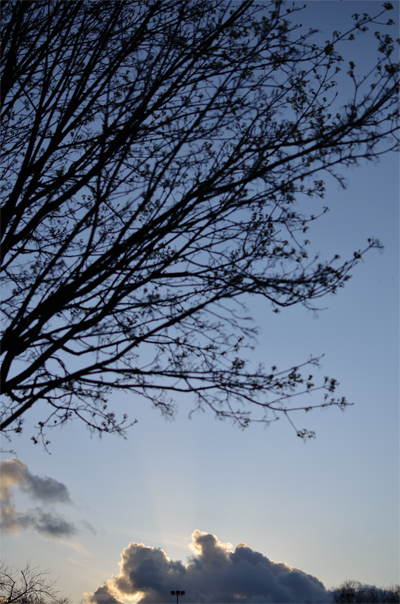
This is a set of silhouette photographs taken on 10 April 2012 in the Cae. There are some lessons to be learned about composition, focus and depth of field. There is also a more fundamental conclusion: it’s important to take the time to plan a photograph, prepare the camera accordingly, consider the scene and then, finally, shoot deliberately.
Subject
As shown in the landscape version below, the subject is tree branches silhouetted against the evening sky. The pictures were taken at around 7.30pm on 10 April 2012. The sun had not quite set, but was obscured by clouds on the horizon.
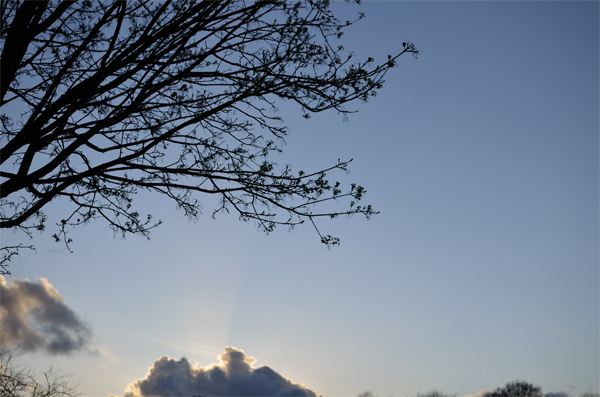
Branches silhouetted against the evening sky
Preparation
There was no particular plan for these pictures. The camera had just been used for Carlo photos and no time was taken to make proper adjustments to accommodate the change to a landscape scene.
Commentary
Focus
The biggest issue with these pictures is focus. They were taken with the 35mm 1.8G lens, and the aperture was left at f2.8. A much deeper depth of field would have helped keep things in focus.

First (and worst) version
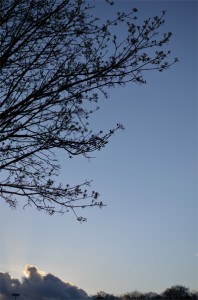
Better focus
The picture on the left (120304_Portrait_3) has the most obvious focus problem. Focus was actually set on the sky, so the branches are blurred.
The camera was focused properly on the branches in the picture on the right (120304_Portrait_2). The shallow depth of field means, however, that the backlit cloud is quite fuzzy.
Composition
For all the pictures in this set, the idea was to try to catch the silhouetted branches and the backlit cloud. In both these picture, a nice beam of sunlight is just about visible rising up from the main cloud. The view on the horizon underneath the cloud was cluttered and distracting. That’s why the bottom of the frame is much higher than it probably should be. It would have been nice to show more cloud and a straightforward plain horizon at the bottom of the picture.
The composition is OK in the left-hand picture. There’s quite a lot of cloud shining in the sunlight, and the branches fill the top half of the frame in quite a nice diagonal.
Unfortunately, less of the cloud is visible in the right-hand composition. Maybe having the top-right ends of the branches visible in this version is a bit better than just showing the branches going off the edge of the frame.
Best Version
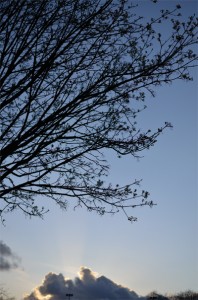
Best Portrait Version
This is probably the best portrait version. The branches are in focus, but there’s still the problem of the shallow depth of field.
A reasonable amount of cloud is included and the sunbeam is quite visible. You can see one of the rugby training pitch floodlights at the bottom of the frame – directly below the sunbeam. That’s part of the cluttered horizon. It would have been nice to have at least the existing height of the cloud added to the bottom of the frame.
The shape of the branches in this photo is quite nice, framing the brightest part of the sky. The branches reach the top-right corner of the frame, which might not be ideal. This version and the landscape one above are probably the most satisfactory.
Conclusion
The photos were taken in a hurry and the aperture setting is wrong. Focus was also set on the wrong thing in the first version. Apart from those technical issues, the biggest problem is that the composition was hurried too.
There was no plan for these pictures and no time was taken to prepare the camera beforehand. Some more time taken to look at the scene would have helped. In summary, more deliberate shooting might have made these photos better.
Larger versions of each of the photos can be viewed in the Gallery below.
%%wppa%%
%%album=5%%